
For British manufacturers in 2026, the gap between production efficiency and commercial agility is narrowing fast. You are likely facing a market where product quality alone is no longer the sole differentiator. Service speed and data visibility are just as vital. A robust manufacturing CRM is no longer just a digital address book, but it is the engine that connects your back-office operations with your front-line sales efforts.
The right system transforms how you manage relationships, moving you away from disjointed spreadsheets and towards a unified view of your business. Whether you are a marketing director in a SaaS firm serving the industrial sector or an operations manager seeking to streamline workflows, get ready to learn how to turn data into actionable revenue.

Key takeaways
- Current manufacturing CRMs have evolved from simple databases to AI-driven operational hubs that predict demand.
- Successful implementation relies heavily on correct integration with existing ERP systems to keep everything in one place.
- Prioritising user adoption and data cleanliness is key when migrating from legacy systems.
The evolution of CRM in the manufacturing sector
Historically, the manufacturing industry has been slower to adopt digital transformation compared to sectors like retail or finance. That being said, UK manufacturing trends in 2026 indicate a massive shift away from on-premise servers toward flexible, cloud-native ecosystems. The days of sales teams operating in isolation, unaware of stock levels or production delays, are ending.
Current industrial CRM solutions are now designed to handle complex account hierarchies and long sales cycles typical of the sector. The priority has moved from purely logging calls to intelligent forecasting. Legacy system migration is a major theme this year, as companies continue to retire outdated software that cannot communicate with modern tools. You need a system that doesn't just store data but actively helps you interpret it to secure better margins.
Features that British manufacturers need to prioritise
When evaluating a new platform, it's easy to get distracted by flashy AI marketing features. But try to keep your eyes on the prize, or the most important, non-negotiable basic features. These include:
- Enterprise resource planning integration: Your CRM needs to talk to your ERP in real time. If a salesperson closes a deal, the production team should know instantly, and inventory levels should update automatically.
- Supply chain visibility: In a volatile global market, your sales team needs to know if raw materials are delayed before they promise a delivery date. A good CRM reflects these supply chain insights directly in the sales pipeline management view.
- Lead-to-order process: Speed is essential. The ability to configure complex quotes (CPQ) and convert a lead to a confirmed order with a single click reduces administrative lag and accelerates cash flow.
- Cloud-based manufacturing software: Remote access is a must for field sales teams. They need to check stock, pull up technical specs and sign contracts from a tablet while standing in front of a client.
2026 comparison: leading CRM solutions for manufacturing
While there are dozens of platforms available, three key players continue to dominate the conversation in 2026, each with distinct strengths for manufacturers.
Salesforce Manufacturing Cloud
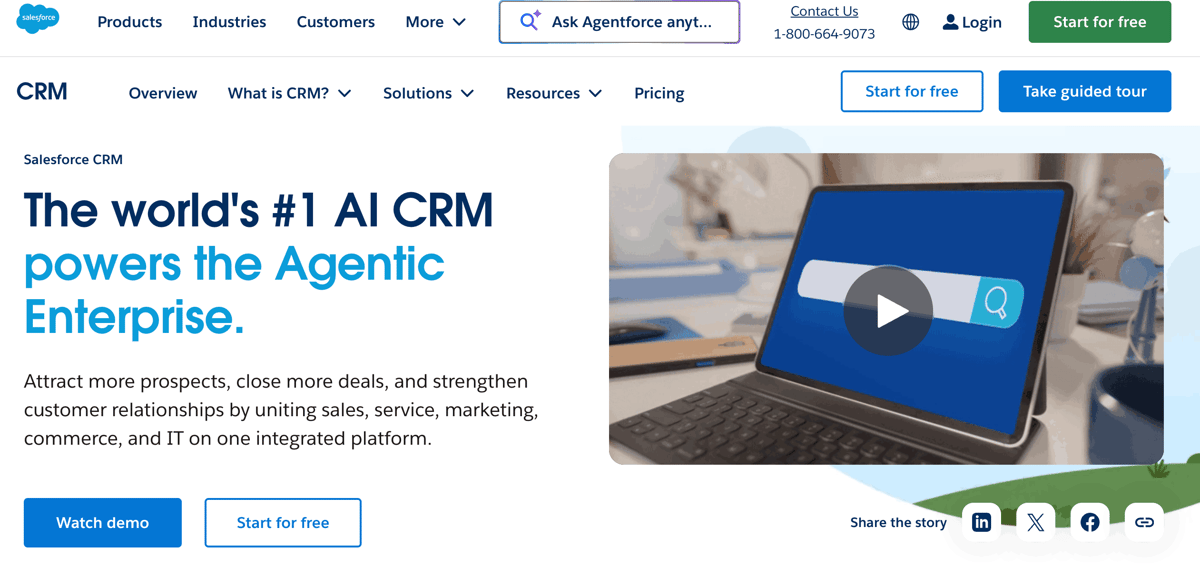
Salesforce remains the top choice for large enterprises requiring high levels of customisation. Their specific Manufacturing Cloud offers 'sales agreements' objects that track planned vs. actual revenue, (a critical metric for run-rate business). With the latest updates, their 'Agentforce' AI agents can autonomously handle routine service inquiries, freeing your team for strategic work. It is powerful but requires a significant investment in implementation and maintenance.
HubSpot
Once seen purely as a marketing tool, HubSpot has matured into a serious contender for manufacturers. Its Operations Hub makes data syncing relatively easy compared to its competitors. For mid-sized companies, HubSpot offers the best balance of power and usability. It excels at sales pipeline management and marketing automation, helping you nurture long-term industrial leads without the steep learning curve of Salesforce.
Microsoft Dynamics 365
If your company runs on the Microsoft ecosystem (Outlook, Teams, Azure), Dynamics 365 is a logical choice. Its strength lies in its native enterprise resource planning integration with Business Central and Finance & Operations. It provides a unified data model that is often easier to maintain for IT teams already managing a Microsoft stack. However, the user interface can feel more rigid than HubSpot’s design.
Implementation strategy: avoiding common pitfalls
Choosing the software is only the first step, as the real challenge lies in deployment. Many manufacturing CRM projects fail not because of the technology, but because of poor change management. Here are a few tips to help you get started with your new CRM implementation:
-
Think of data hygiene as the foundation: Before you migrate, audit your existing data. Do not transfer duplicate contacts or obsolete records into your new system. Clean data makes it so that your reporting is accurate from day one.
-
Focus on adoption: Industrial sales teams are often resistant to changing their workflows. Involve them early in the process. Show them how the new system saves them time by automating quote generation for example rather than just presenting it as a management tracking tool.
-
Start small and scale: Do not try to launch every feature at once. Begin with core contact management and the lead-to-order process, then add on advanced automation and AI forecasting once the team is comfortable.
Conclusion
Choosing the right manufacturing CRM for 2026 is about selecting a strategic partner for your growth. By prioritising integration, visibility and user adoption, you can build a system that not only manages relationships, but also actively drives production efficiency and sales revenue.
Whether you choose Salesforce, HubSpot or Dynamics, make sure that your choice aligns with your long-term operational goals.


David Tomas
CEO and co-founder of Cyberclick. David Tomas has more than 25 years of experience in the online world. He is an engineer and completed an Entrepreneurship program at MIT, Massachusetts Institute of Technology. In 2012 he was named one of the 20 most influential entrepreneurs in Spain, under the age of 40, according to Global Entrepreneurship Week 2012 and IESE. Author of "The Happiest Company in the World" and "Diary of a Millennial".

Leave your comment and join the conversation